|
Books
 Antinomies of Art and Culture: Modernity, Postmodernity, Contemporaneity.
Editors: Terry Smith, Okwui Enwezor,
and
Nancy Condee. 456 pages (October 2008) 77 illustrations
In this landmark collection, world-renowned theorists, artists, critics, and curators explore new ways of conceiving the
present and understanding art and culture in relation to it. They revisit from fresh perspectives key issues regarding
modernity and postmodernity, including the relationship between art and broader social and political currents, as well as
important questions about temporality and change. They also reflect on whether or not broad categories and terms such as
modernity, postmodernity, globalization, and decolonization are still relevant or useful. Including twenty essays and
seventy-seven images, Antinomies of Art and Culture is a wide-ranging yet incisive inquiry into how to understand, describe,
and represent what it is to live in the contemporary moment.
In the volume's introduction the theorist Terry Smith argues that predictions that postmodernity would emerge as a
global successor to modernity have not materialized as anticipated. Smith suggests that the various situations of decolonized
Africa, post-Soviet Europe, contemporary China, the conflicted Middle East, and an uncertain United States might be better
characterized in terms of their "contemporaneity," a concept which captures the frictions of the present while denying
the inevitability of all currently competing universalisms. Essays range from Antonio Negri's analysis of contemporaneity
in light of the concept of multitude to Okwui Enwezor's argument that the entire world is now in a postcolonial
constellation, and from Rosalind Krauss's defense of artistic modernism to Jonathan Hay's characterization of
contemporary developments in terms of doubled and even para-modernities. The volume's centerpiece is a sequence of
photographs from Zoe Leonard's Analogue project. Depicting used clothing, both as it is bundled for shipment in Brooklyn
and as it is displayed for sale on the streets of Uganda, the sequence is part of a striking visual record of new cultural
forms and economies emerging as others are left behind.
 Contemporary Art + Philanthropy.
Edited by Terry Smith, 104 pages, 195 x 180
mm, hardback,
clothbound, 2007.
What are the major changes in world contemporary art? How might independent, non-commercial and openhearted private
foundations take stock of these changes and make a distinctive contribution to sustaining valuable contemporary art and to
increasing enlightened understanding of it?
These questions were posed at a one-day forum held at Sherman Galleries, Sydney, on 10 August 2006, entitled "Public
Spaces/Private Funding: Foundations for Contemporary Art".
In this volume, Professor Terry Smith, David Elliott, Lynne Cooke, Rupert Myer AM and Dr Gene Sherman respond from scholarly,
art critical, curatorial and philanthropic points of view. They assess the work of foundations in many parts of the world and
outline the climate for philanthropy in Australia.
Their main focus is the increasingly pertinent question: How might private initiatives most help contemporary art in Australia,
now and in the foreseeable future, taking into account the regional and international contexts in which art is produced and
circulates?
All publications are available for sale through Sherman Contemporary Art Foundation. To enquire about or purchase a title,
please contact Jaime Wheatley, tel 61 2 9331 1112 or email info@sherman-scaf.org.au
 The
Architecture of Aftermath. Smith, Terry, 280 p., 58 halftones.
7 x 10 2006 The
Architecture of Aftermath. Smith, Terry, 280 p., 58 halftones.
7 x 10 2006
Cloth $75.00sc 0-226-76468-0 Spring 2006; Paper $30.00sp 0-226-76469-9
Spring 2006
The September 11 terrorist attacks targeted, in Osama bin Laden’s
words, “America’s icons of military and economic power.”
In The Architecture of Aftermath, Terry Smith argues that it was
no accident that these targets were buildings: architecture has
long served as a symbol of proud, defiant power—and never
more so than in the late twentieth century.
But after September 11, Smith asserts, late modern architecture
suddenly seemed an indulgence. With close readings of key buildings—including
Jørn Utzon’s Sydney Opera House, Minoru Yamasaki’s
World Trade Center, Frank Gehry’s Guggenheim Museum Bilbao,
and Richard Meier’s Getty Center—Smith traces the growth
of the spectacular architecture of modernity and then charts its
aftermath in the conditions of contemporaneity. Indeed, Smith focuses
on the very culture of aftermath itself, exploring how global politics,
clashing cultures, and symbolic warfare have changed the way we
experience destination architecture.
Like other artists everywhere, architects are responding to the
idea of aftermath by questioning the viability of their forms and
the validity of their purposes. With his richly illustrated The
Architecture of Aftermath, Smith has done so as well.
TABLE OF CONTENTS
Acknowledgments
List of Illustrations
Introduction: After Effects—Architecture, Iconomy, Contemporaneity
Part I: Dispacing Time
1. The Bilbao Affect: Culture as Industry
2. Flashback: Uluru and the Sydney Opera House
3. The Past-Modern Present: Empire Redux at the Getty Center
4. Remembrance Now: Architecture after Auschwitz at the Jewish Museum,
Berlin
Part II: Targets and Opportunities
5. WTC Fast Forward: Skyscrapers on the Isle of the Dead
6. Architecture’s Unconscious: Trauma and the Contemporary
Sublime at Ground Zero
7. Shock.Build.Mourn.Hope: Architects Confront Contemporaneity
Conclusion: Aftermath and After
Notes
Index
 Transformations
in Australian Art, Volume 1: The 19th Century - Landscape, Colony
and Nation, Smith, Terry, Sydney, Craftsman House, B V I, Thames
& Hudson (Australia), 2002 Transformations
in Australian Art, Volume 1: The 19th Century - Landscape, Colony
and Nation, Smith, Terry, Sydney, Craftsman House, B V I, Thames
& Hudson (Australia), 2002
TABLE OF CONTENTS
Acknowledgments
Introduction: The Visual Cultures of Colonialism
1. Convicts and Capital: The visual economy of surveillance
2. Land Into Landscape: The setting of settlement
3. The Divided Meaning of Shearing the Rems: Artists and
nationalism, 188-1895
4. Landscape with Feeling: Golden summers and modern life
List of Figures
Index
 Transformations
in Australian Art, Volume 2: The 20th Century - Modernism and Aboriginality,
Smith, Terry, Sydney, Craftsman House, B V I, Thames & Hudson
(Australia), 2002 Transformations
in Australian Art, Volume 2: The 20th Century - Modernism and Aboriginality,
Smith, Terry, Sydney, Craftsman House, B V I, Thames & Hudson
(Australia), 2002
TABLE OF CONTENTS
Acknowledgments
Introduction: Mismatch/Misfit: Modernism and Aboriginality
1. What was Australian Modernism?
2. Adopt, Adapt, Transform! Modernist strategies in Margaret Preston's
Still Life, 1927
3. Albert Namatjira and Margaret Preston: Changing an unequal exchange
4. Abstraction in the 1950s and 1960s: Making it local
5. THe Provincialism Problem
6. Conceptual Art is Transit
7. Aboriginality and Post-modernity: Parallel lives
List of Figures
Index
 Impossible
Presence: Surface and Screen in the Photogenic Era. Smith,
Terry, editor, University of Chicago Press. Co-published with Power
Publications, Sydney. 309 p. 6 x 9 2001 Impossible
Presence: Surface and Screen in the Photogenic Era. Smith,
Terry, editor, University of Chicago Press. Co-published with Power
Publications, Sydney. 309 p. 6 x 9 2001
Cloth ANZ $55.00sc 0-226-76384-6 Fall 2001, Paper $22.00sp 0-226-76385-4
Fall 2001 Australia and New Zealand sales via Power
Institute, University of Sydney or the University
of Chicago Press
Impossible Presence brings together new work in film studies, critical theory, art history, and anthropology for a multifaceted exploration of the continuing proliferation of visual images in the modern era. It also asks what this proliferation--and the changing technologies that support it--mean for the ways in which images are read today and how they communicate with viewers and spectators.
Framed by Terry Smith's introduction, the essays focus on two kinds of strangeness involved in experiencing visual images in the modern era. The first, explored in the book's first half, involves the appearance of oddities or phantasmagoria in early photographs and cinema. The second type of strangeness involves art from marginalized groups and indigenous peoples, and the communicative formations that result from the trafficking of images between people from vastly different cultures. With a stellar list of contributors, Impossible Presence offers a wide-ranging look at the fate of the visual image in modernity, modern art, and popular culture.
Contributors:
Jean Baudrillard
Marshall Berman
Jeremy Gilbert-Rolfe
Elizabeth Grosz
Tom Gunning
Peter Hutchings
Fred R. Myers
Javier Sanjines
Richard Shiff
Hugh J. Silverman
Terry Smith
TABLE OF CONTENTS
Preface and Acknowledgments
Introduction
Enervation, viscerality: the fate of the image in Modernity
Terry Smith
1. Too much is not enough: metamorphoses of Times Square
Marshall Berman
2. New thresholds of vision: instantaneous photography and the early
cinema of Lumière
Tom Gunning
3. Through a fishwife's eye: between Benjamin and Deleuze on the
timely image
Peter J. Hutchings
4. Realism of low resolution: digitisation and modern painting
Richard Shiff
5. Beauty and the contemporary sublime
Jeremy Gilbert-Rolfe
6. Andy Warhol: snobbish machine
Jean Baudrillard
7. Andy Warhol: chiasmatic visibility
Hugh J. Silverman
8. Naked
Elizabeth Grosz
9. Visceral Cholos: desublimation and the critique of Mestizaje
in the Bolivian Andes
Javier Sanjines
10. Traffic in culture: on knowing Pintupi painting
Fred R. Myers
11. Warped Space: architectural anxiety in digital culture
Anthony Vidler
List of Images
Notes on Contributors
 Jacques
Derrida: Deconstruction Engaged The Sydney Seminars, edited
by Paul Patton and Terry Smith, Power Publications, Sydney 2001 Jacques
Derrida: Deconstruction Engaged The Sydney Seminars, edited
by Paul Patton and Terry Smith, Power Publications, Sydney 2001
ISBN 1 86487 433 3, 119pp, paper
Price: A$19.95 (with GST A$21.95)
From Power
Institute, University of Sydney
Jacques Derrida's two Sydney seminars of August 1999 enabled him
to present some of the principal themes of his work to non-specialist
audiences. As might be expected of a Sydney setting, warmth of feeling
and openness of spirit pervaded both occasions. Derrida's willingness
to engage with both interlocutors and audiences ensured an exciting
demonstration of the subtlety and flexibility of deconstructive
thinking in action. This book is reconstructed from the transcripts
of those sessions. It provides a clear, systematic and highly accessible
introduction to many of the central concerns of Derrida's engagement
with philosophy, visual art and politics.
 In
Visible Touch: Modernism and Masculinity, Smith, Terry, editor.
University of Chicago Press. Co-published with Power Publications,
Sydney. In
Visible Touch: Modernism and Masculinity, Smith, Terry, editor.
University of Chicago Press. Co-published with Power Publications,
Sydney.
258 p., 83 halftones. 8 x 9-1/2 1998
Cloth ANZ $60.00sc 0-226-76411-7 Spring 1998
Paper $25.00sp 0-226-76412-5 Spring 1998 Australia and New Zealand
sales via Power
Institute, University of Sydney or via University
of Chicago Press
In this collection, outstanding historians and theorists explore
the representation of heterosexual masculinity embodied in modernist
art. Examining such major European modernists as Cézanne,
Caillebotte, Matisse, Wyndham Lewis, and Boccioni, these writings
offer a history of how artists sought to shape their sexuality in
their work. In turn, the essays also show how the artists were shaped
by the historical shifts in the gender order and by the exchanges
between sexualities occurring in their social worlds. For example,
the piece on Wyndham Lewis shows how he subscribed to an exaggerated
masculinism, while the essays on Boccioni and Matisse bring out
the efforts by these men to understand feminine sexuality. In the
theoretical essays, Bernard Smith questions modernism itself as
a style category. And Richard Shiff and W.J.T. Mitchell trace the
consequences for art theory of recognizing the physical presence
of modernist artworks and the agency of imagery in our encounter
with contemporary art.
TABLE OF CONTENTS
Preface and Acknowledgments
Introduction: Intensity: Modernism's Phallic Aesthetics by Terry
Smith
Ch. 1: Freud's Cezanne
T. J. Clark
Ch. 2: Masculinity, Muscularity and Modernity in Caillebotte's Male
Figures
Tamar Garb
Ch. 3: Expression, Disfiguration: Matisse, the Female Nude and the
Academic Eye
Roger Benjamin
Ch. 4: Mother and Son: Boccioni's Paintings and Sculpture 1906-1915
Virginia Spate
Ch. 5: The Popular Culture of Kermesse: Lewis, Painting and Performance
1912-13
Lisa Tickner
Ch. 6: Modernity and the Formalesque
Bernard Smith
Ch. 7: Breath of Modernism (Metonymic Drift)
Richard Shiff
Ch. 8: What do Pictures Want? An Idea of Visual Culture
W. J. T. Mitchell
Ch. 9: Gloria Patri: A Conversation about Power, Sexuality and War
Mary Kelly, Terry Smith.
List of Images
Notes on Contributors
Ideas of the University
edited by Terry Smith
Power Publications, University of Sydney, Co-published with the
Research Institute for the Humanities and Social Sciences, The University
of Sydney, 1996
Does the university have a future? Has the modern university failed?
Is it, as Bill Readings has claimed, in ruins? The authors in this
volume remain positive about the potential of universities to create
the conditions of their own reinvention, by renewing themselves
from within and by working in concert with the communities around
them. They pose sharply critical questions about how universities
are being shaped by varying degrees of internal doubt, external
antipathy yet increasing public need. Addressing topics ranging
from the current political crisis around Australian universities
to the persistence of medieval conceptions of knowledge, they ask:
what forms will the university take in postmodernity?
Samuel Weber explores the impact of globalisation and virtualisation
on universities world-wide, and Gavin Brown poses the challenges
for the University of Sydney. Diane Austin-Broos emphasises the
importance of local knowledges, and Paul Patton the university as
the site of a series of productive problems. Based on a Symposium
held at the University of Sydney in 1996, and containing a record
of the discussion following these talks, this volume is envisaged
as the first in a series.
ISBN 1 86451 248 2
4 b/w images
Price: A$11.00 (with GST $14.25) via Power
Institute, University of Sydney
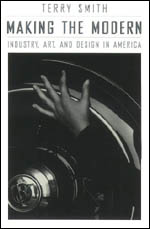 Smith,
Terry Making the Modern: Industry, Art, and Design in America.
University of Chicago Press 528 p., 156 halftones. 6-5/8 x 9-3/8
1993 Smith,
Terry Making the Modern: Industry, Art, and Design in America.
University of Chicago Press 528 p., 156 halftones. 6-5/8 x 9-3/8
1993
Paper $37.50sp 0-226-76347-1 Fall 1994
sales via University
of Chicago Press
In this ambitious book, Terry Smith chronicles the modernist revolution
in American art and design between the world wars--from its origins
in the new industrial age of mass production, automation, and corporate
culture to its powerful and transforming effects on the way Americans
came to see themselves and their world. From Ford Motor's first
assembly line in 1913 to the New York World's Fair of 1939, Smith
traces the evolution of visual imagery in the first half of America's
century of progress.
TABLE OF CONTENTS
List of Illustrations
Acknowledgments
Introduction: The Visual Imagery of Modernity
Pt. 1: The Modernization of Work: Detroit, 1910-1929
1: Fordism: Mass Production and Total Control
2: Architecture and Mass Production: The Functionalism Question
3: Henry Ford and Charles Sheeler: Monopoly and Modernism
4: The Garden in the Machine
Pt. 2: Modernization and National Dissensus: Imagery of Reality
in the 1930s
5: The Shaping of Seeing: Outrageous Fortune
6: The Resistant Other: Diego Rivera in Detroit
7: Frida Kahlo: Marginality and Modernity
8: Of the People, For the People
9: Official Images, Modern Times
Pt. 3: Design or Revolution? Styling Modernity in the 1930s
10: Designing Design: Modernity for Sale
11: "Pure" Modernism Inc.
12: Funfair Futurama: A Consuming Spectacle
Pt. 4: The Modern Effect
13: Modernity becomes Normal
Notes
Index
List of books
The Architecture of Aftermath, Chicago, University
of Chicago Press, 2006
Transformations, vol. 1, Nineteenth Century Australian Art: Landscape,
Colony and Nation; vol. 2. Twentieth Century Australian Art: Modernism
and Aboriginality, Sydney: Craftsman House, 2002
Editor, with Paul Patton, Jacques Derrida, Deconstruction Engaged:
The Sydney Seminars, Sydney: Power Publications, 2001 (Japanese
edition, Tokyo: Minori, 2005)
The Code of Practice for the Australian Visual Arts and Craft Sector
(National Association of the Visual Arts: Sydney, 2001, general
editor Caroline Jordan). Report of the Visual Arts Industry Guidelines
Research Project, 1998-2001, of which I was joint Chief Investigator
(2nd ed. 2004, general editor Penny Craswell).
What is Contemporary Art? Contemporary Art, Contemporaneity and
Art to Come, Sydney, Artspace Critical Issues Series, 2001 (pamphlet)
Editor, Impossible Presence: Surface and Screen in the Photogenic
Era, Sydney, Power Publications, Chicago, University of Chicago
Press, 2001 (Introduction; essays by Marshall Berman, Tom Gunning,
Peter Hutchings, Jean Baudrillard, Hugh Silverman, Jeremy Gilbert-Rolfe,
Elizabeth Grosz, Javier Sanjines, Fred R Myers, Anthony Vidler)
Editor, First People, Second Chance; The Humanities and Aboriginal
Australia, Canberra, Australian Academy of the Humanities, 1999
(Introduction; essays by Marcia Langton, Henry Reynolds, Paul Patton,
Margaret Clunies Ross and Ian McLean.)
Editor (with Jennifer Allison, Katherine Gregouras, George Symons),
From Vision to Sesquicentenary, The University of Sydney through
its Art Collection, Sydney, Standing Committee of Convocation of
the University of Sydney, 1999 (Introduction; essays by various
authors.)
Editor, In Visible Touch: Modernism and Masculinity, Sydney, Power
Publications, 1997, Chicago, University of Chicago Press, 1998 (Introduction;
essays by T.J.Clark, Tamar Garb, Roger Benjamin, Virginia Spate,
Richard Shiff, Bernard Smith, W.J.T. Mitchell, Mary Kelly.)
Editor, Ideas of the University, Sydney: Research Institute for
the Humanities and Social Sciences and Power Publications, 1996
(Introduction, essay by Samuel Weber, discussion.)
Making the Modern: Industry, Art and Design in America, Chicago:
University of Chicago Press, 1993, 532 pages
Editor, Constructing Australian Art: Eight Critiques, Sydney: Power
Institute of Fine Arts Occasional Paper No 2, May 1986, 109 pages
(with Anthony Bradley) Editor, Australian Art and Architecture:
Essays Presented to Bernard Smith, Oxford University Press, Melbourne
1980, 263 pages
Art & Language: Australia 1975, Art & Language Press, Banbury,
New York, Sydney 1976, 231 pages
(with Ian Burn and Mel Ramsden) Draft for an Anti-Textbook, special
issue, Art-Language, Vol.3, No 1, Sept 1974, 110 pages
(with Ian Burn, Mel Ramsden, et al.) Handbook, Art & Language
Press, New York, and the Mezzanine, Nova Scotia College of Art,
Halifax, N.S. 1973, 92 pages
|
